



The SBA 504 loan is built for owner-occupied commercial real estate and long-life equipment, with fixed rates and a typical 10% down payment. The USDA Business & Industry (B&I) loan is a lender guarantee for rural projects that can also cover working capital. If you are buying or building a property or buying heavy machinery, 504 is usually the more direct fit. If your project sits in a rural area and needs working capital too, B&I deserves a look.
Fbdc
Explore SBA 504 Financing
FBDC specializes in SBA 504 loans for small businesses acquiring commercial real estate, heavy machinery, and equipment.
The two programs share a goal, which is long-term financing for businesses that need it. They are built differently.
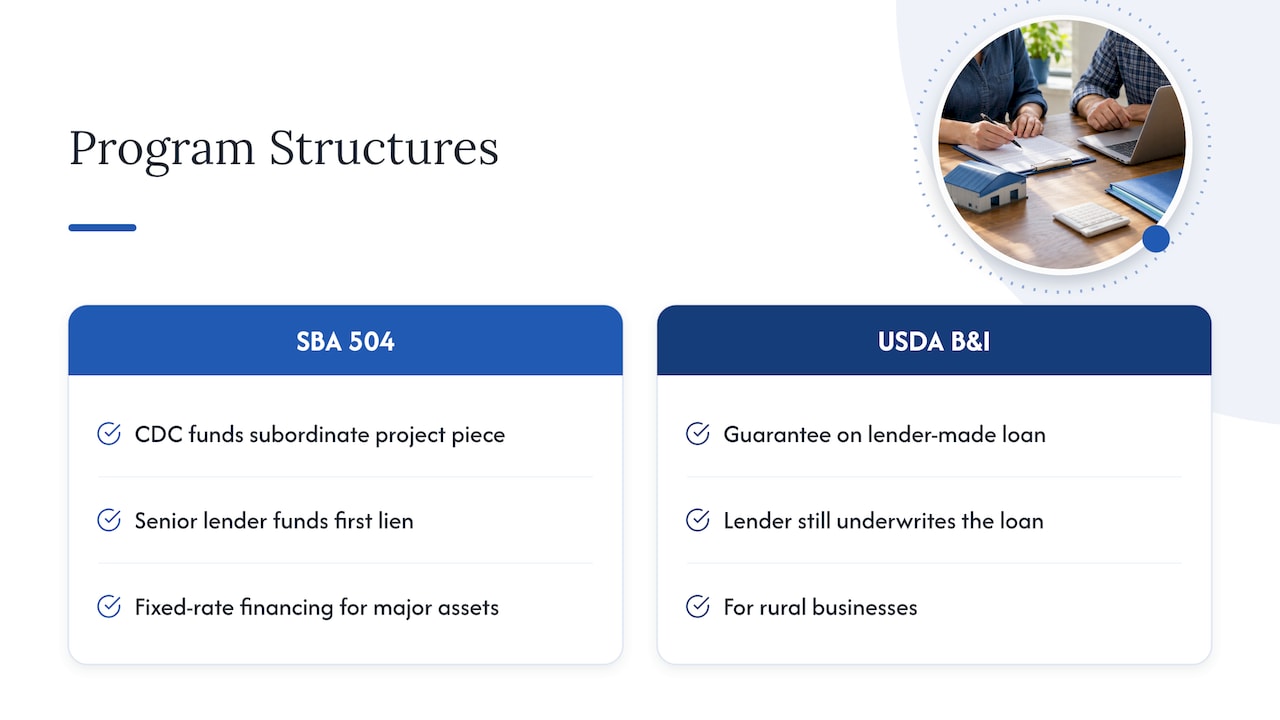
An SBA 504 loan is delivered through an SBA-authorized nonprofit Certified Development Company working with a senior lender. The CDC funds a subordinate piece of the project, and a bank or other senior lender funds the first lien. SBA describes 504 as long-term, fixed-rate financing for major fixed assets that promote business growth and job creation.
The USDA B&I Guaranteed Loan Program works differently. USDA guarantees loans that regulated lenders make to rural businesses. The lender still underwrites the loan. As the OCC explains, the guarantee reduces the lender’s exposure but does not replace underwriting. USDA still requires reasonable assurance of repayment, adequate collateral, financial analysis and environmental review.
In short, 504 is a two-lender structure for fixed assets. B&I is a guarantee on a single lender’s loan, tied to rural impact.
SBA 504 borrowers must be operating, for-profit U.S. small businesses. They cannot be engaged in ineligible, passive or speculative activities. They must also show qualified management, a feasible business plan, good character and the ability to repay.
SBA also sets size limits. A business must have a tangible net worth of less than $15 million and average net income below $5 million after federal income taxes for the two years before applying. Nonprofits are not eligible.
If you are a Florida owner checking these points, our guide to SBA 504 eligibility in Florida walks through four checks to run before you talk to a CDC. Owner-occupancy matters too, and our occupancy checklist covers it.
USDA says eligible B&I applicants include for-profit and nonprofit businesses, cooperatives, federally recognized Tribes, public bodies and individuals engaged or proposing to engage in a business. An individual borrower must be a U.S. citizen or lawfully admitted permanent resident. Private entities must keep loan funds in the United States and primarily create or save jobs for rural U.S. residents.
Neither program is closed to startups or veteran owners. Under 504, a new business must still show a feasible plan and capable management. B&I generally asks new businesses for more equity (see below). If you are a veteran owner, FBDC’s VetLoan Advantage Plus is designed for low down payments and fixed rates.
This is where the two diverge most, so match the loan to your project first.
Use of fundsSBA 504USDA B&IBuy, build or renovate real estateYesYes, in an eligible rural areaHeavy machinery and equipmentYes, with at least 10 years of remaining useful lifeYesWorking capital and inventoryNoWorking capital yesStartup costsNot a stated useYesRefinancingQualifying debt only, under 13 CFR 120.882 conditionsQualifying debt under certain conditionsRental real estate investment or speculationNoNot a stated use
SBA says 504 proceeds may purchase, construct or renovate buildings and land, and acquire long-term machinery and equipment with at least 10 years of remaining useful life. The same page says proceeds cannot fund working capital, inventory, nonqualifying debt refinancing, speculation, or investment in rental real estate.
USDA’s FAQ says B&I proceeds may fund acquisitions, construction, conversion, expansion, repair, modernization, equipment, machinery, supplies, startup costs, working capital and qualifying debt refinancing.
So the question is what you are buying. A building, land or a heavy machine is what 504 was designed around. For a deeper look, see our guides on a 504 loan to buy a commercial building in Florida and when equipment loans beat leases. If your plan includes buying a business or other costs that 504 does not cover, compare SBA business acquisition financing for how eligible costs and refinancing differ.
504 has no rural test. You need an operating for-profit small business in the U.S. and an eligible project. B&I’s normal location rule covers rural areas outside cities or towns with more than 50,000 inhabitants and their contiguous and adjacent urbanized areas. A project in a large Florida metro area is generally outside B&I’s reach. A project in a small town may be inside it. Check the specific address with USDA Rural Development before you plan around it.
FeatureSBA 504USDA B&ITypical equityAbout 10%Generally 10% existing, 20% new businessStructureSenior lender about 50%, CDC/SBA about 40%, borrower about 10%One lender loan with USDA guaranteeMaximum SBA debenture$5.5 millionSet by program limits and projectTerms10, 20 and 25 years7 years working capital, 15 years or useful life for equipment, 30 years real estateRateFixed on the CDC portionNegotiated: fixed, variable or combined
The USDA and SBA comparison matrix describes a typical 504 capital stack as a senior lender loan of about 50%, a CDC/SBA loan of about 40% and borrower equity of about 10%. USDA’s FAQ says B&I tangible balance-sheet equity is generally 10% for existing businesses and 20% for new businesses, with higher requirements possible when warranted. At FBDC, down payments can be as low as 10% on 504 projects. Our article on the 10% down owner-occupied loan shows how that works.

SBA lists a $5.5 million maximum loan amount and 10-, 20- and 25-year maturities for 504. Our guide to 504 10, 20 and 25 year terms explains which maturity suits which asset.
For B&I, USDA’s FAQ gives 7 years for working capital, 15 years or useful life (whichever is less) for machinery and equipment, and 30 years for real estate. Rates are negotiated between lender and borrower and may be fixed, variable or a combination. The OCC notes that rates may differ between the guaranteed and unguaranteed portions and are subject to USDA review.
The practical difference is predictability. A fixed rate on the CDC portion of a 504 loan lets you budget the payment for the life of that portion.
For FY2026, the Federal Register notice sets the B&I initial guarantee fee at 3.0% of the guaranteed amount for loans under $5 million and loans from $5 million to $25 million. The annual retention fee is 0.55% of the outstanding guaranteed principal balance. Reduced-fee B&I loans carry a 1.0% guarantee fee and a 0.50% retention fee. These rates are set yearly, so confirm the current figures before you commit.
On 504, borrower-paid CDC fees are included in the debenture. The 2021 comparison matrix showed the annual service fee as a range of 0.642% to 0.682%. Fees change, so ask your CDC for its current disclosure. FBDC’s 504 loan page lists the approximate fees.
B&I requires collateral sufficient to protect the lender and USDA. The OCC says collateral must secure the entire guaranteed loan, with equal lien priority for the guaranteed and unguaranteed portions. In 504, the matrix says the SBA/CDC lien is generally second on the project, behind the third-party lender’s first lien. The project itself, the building or equipment, is the core collateral.
Work through these questions in order.
If you also need to compare 504 with a bank loan, our pages on 504 vs. a conventional commercial mortgage, 504 vs. 7(a) and CMBS vs. 504 cover those side by side.
At FBDC, we have worked with SBA 504 lending for more than 35 years, and we see the same pattern. Owners who need a building or heavy equipment want a low down payment, a long term and a payment that does not move. That is what 504 is designed to deliver.
B&I is a useful rural guarantee tool. But when the project is a property or machinery purchase, the 504 structure is built for exactly that purpose. It pairs a senior lender with a CDC loan so you can bring as little as 10% to the table.
We aim to make the process swift and clear. Our team guides you through each step, from eligibility to closing, and we offer a bridge loan program, refinancing, direct lending and a program for veterans so more project types have a path.
PHENYX
If you are planning to acquire, build, renovate or refinance commercial real estate, or buy equipment with a useful life of at least 10 years, FBDC can structure a 504 loan around your project. We also offer a 504 refinance program, a bridge loan program and direct lending for smaller loans.
Start with our SBA 504 loan page, or schedule a consultation with our team to review your project.
No. SBA states that 504 proceeds cannot fund working capital or inventory. They are meant for buildings, land and long-term machinery and equipment. Use the loan for the fixed asset and arrange working capital separately.
Yes, in the normal case. The program targets rural areas outside cities or towns with more than 50,000 inhabitants and their adjacent urbanized areas. Private borrowers must also primarily create or save jobs for rural U.S. residents.
A typical 504 structure uses about 10% borrower equity, and FBDC offers 504 down payments as low as 10%. USDA says B&I equity is generally 10% for existing businesses and 20% for new ones, and can be higher when warranted.
504 provides long-term fixed-rate financing on the CDC portion. B&I rates are negotiated between lender and borrower and may be fixed, variable or a combination.

