


A bridge loan and an SBA 504 loan do different jobs, and for many owner-occupied projects they are two steps of the same plan. A bridge loan is short-term money that lets you close or start a project quickly. An SBA 504 loan is long-term, fixed-rate financing for the building or equipment itself, with a low down payment. If you need to move before the 504 closes, a bridge can cover the gap and the 504 then takes it out. If you have time to wait, you may not need the bridge at all.
This guide explains how each loan is built, what each can pay for, how timing and costs compare, and how to decide. It is written for for-profit Florida business owners who plan to occupy the property or use the equipment in their own operations.
Fbdc
Plan Your Property Financing
FBDC specializes in SBA 504 lending for business property and equipment, with low down payments and long-term fixed rates.
A commercial real estate bridge loan is temporary financing. It is meant to be repaid in a short window by something specific: permanent financing, a sale, or another defined event. Lenders price that short horizon and the exit risk into the loan, so bridge terms are shorter and the cost is typically higher than for permanent financing. The point of a bridge is time. You pay for the ability to act now.
An SBA 504 loan is permanent financing. It is built for major fixed assets, and the SBA describes 504 loans as financing for buildings or land and for long-term machinery and equipment with at least 10 years of useful life remaining. Two lenders share the project. A bank provides a first-lien loan, and a Certified Development Company (CDC) provides a second-lien loan funded through an SBA-guaranteed debenture. The borrower contributes the rest.
The standard structure is often described as a 50-40-10 split: the bank funds about half the project, the CDC funds up to 40%, and you put in 10%. The CDC portion carries a fixed rate for the life of the loan, which is why 504 payments are predictable over 10, 20 or 25 years. Special-purpose properties and newer businesses can require a larger contribution, so confirm your own number with a CDC.

We are a CDC, and 504 lending is what we do. We also offer a bridge product for 504 projects, so we see both sides of this comparison on real deals.
FeatureBridge loanSBA 504 loanPurposeShort-term funding to act quicklyLong-term financing for property and equipmentRepaymentPaid off by a refinance, sale or other exitFully amortizing over the loan termRate structurePriced for short-term risk; terms vary by lenderFixed rate on the CDC portion for the life of the loanDown paymentSet by the bridge lenderAs low as 10% for qualifying projectsTypical useClose a purchase or start work before permanent financingBuy, build, renovate or refinance owner-occupied property; buy long-life equipmentBiggest riskThe exit does not happen on timeEligibility and occupancy rules not metSpeedBuilt to be fasterInvolves a bank, a CDC and SBA processing
Notice what the table implies: you are comparing a tool for timing with a tool for long-term cost. That is why the best answer is often “both, in sequence.”
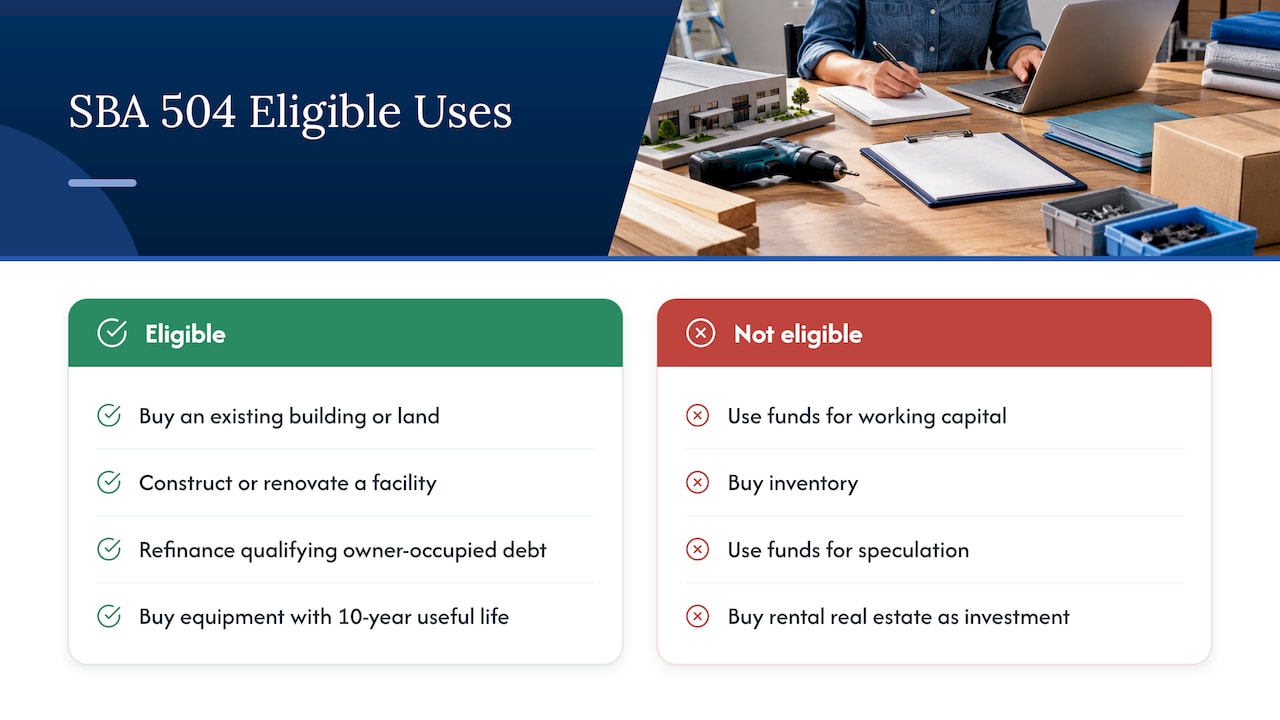
The 504 program is for fixed assets. Eligible uses include purchasing an existing building or land, constructing or renovating a facility, refinancing qualifying debt on owner-occupied property, and buying heavy machinery or equipment that meets the 10-year useful life test. For Florida businesses, our page on buying a commercial building with a 504 loan walks through a typical purchase.
The SBA states that 504 loans cannot be used for working capital, inventory, speculation or investment in rental real estate, and that nonprofit, passive or speculative businesses are not eligible. If your goal is to buy a building as an investment and lease it to others, 504 is not the right program. Our article on owner-occupied versus investment property explains how lenders draw that line.
Because a bridge is a timing tool, its uses depend on the lender and the project. Common situations include closing on a building before the 504 package is complete, starting construction or renovation while permanent financing is being finalized, or holding a property for a short period before the takeout. Our own 504 Velocity Bridge Loan Program is designed for projects headed to a 504 loan, so the bridge has a defined permanent financing plan behind it.
For 504, the borrower must be a for-profit business that will use the asset in its own operations. The owner-user requirement is central. Industry guidance commonly points to occupying at least 51% of an existing building for your own business, and the occupancy rules are worth reading closely before you sign a purchase contract. We summarize them in our SBA 504 occupancy checklist for Florida businesses. For a broader look at eligibility, including recent citizenship-related changes, see our 2026 SBA qualification update.
For a bridge loan, qualification looks different. The lender focuses on the property, your plan for the takeout, and your ability to carry the loan until then. A bridge tied to a 504 project makes the takeout clear, because the permanent financing is being arranged alongside it.
Typical documents for either route include business and personal tax returns, financial statements, a description of the project, and a purchase contract or construction budget. Your lender will give you the exact list.
A 504 project can require as little as 10% from the borrower, compared with the larger equity injection many conventional commercial loans ask for. On a $2,000,000 project, 10% is $200,000 of your own cash. Our page on the 10% down 504 owner-occupied loan shows how that is structured for Florida businesses.
The down payment on a bridge depends on the bridge lender and the property. Ask for it in writing and compare it with the 504 contribution, because the two should not stack into an unexpectedly large cash requirement.
The CDC portion of a 504 loan is fixed for the life of the loan. That removes the rate-reset risk that comes with many conventional loans and makes long-range budgeting simpler. A bridge loan is short by design, so you are paying for flexibility over months rather than locking in cost over decades. Because the structure is temporary, the right way to judge a bridge is its total cost over the months you will actually hold it, plus fees at closing and at payoff.
504 loans carry fees for the CDC, the SBA guarantee and closing, and many of them can be financed into the loan rather than paid at the table. Fee amounts change by fiscal year and by project size, so use a real quote rather than a rule of thumb. Our guide, getting a real SBA 504 fee number before you sign, explains what to ask for. For bridge loans, ask about origination fees, extension fees and prepayment terms before you commit.
A 504 loan involves three parties: a bank, a CDC and the SBA. Underwriting, third-party reports, and SBA authorization all take time, and the schedule depends on how complete your documents are and how quickly the bank and CDC can align. A well-prepared file moves faster.
If a seller will only hold a property for a short window, or a construction schedule cannot wait for the debenture to fund, a bridge solves the problem. It lets you act now with a defined path to the 504 takeout. If the seller can wait, a straight 504 avoids the extra step.
Our approach is to build a clear timeline early. When we see a gap between the closing date and the expected 504 funding, we look at whether a bridge is appropriate rather than discovering the gap in the final week.
A bridge loan has one big dependency: the exit. If the permanent financing does not close on time, you face the payoff date with no replacement. That can mean extension fees, a forced sale, or a rushed refinance on worse terms.
You reduce that risk by choosing a bridge that is connected to a specific permanent plan. Questions to settle before you sign:
Our article on avoiding bridge risk with CRE bridge loans that lead to an SBA 504 goes deeper on this.
Work through these questions in order.
If your real choice is between 504 and other long-term financing rather than a bridge, these comparisons may help: 504 versus 7(a), 504 versus a conventional commercial mortgage in Florida, 504 versus CMBS, and 504 versus USDA B&I.
We rarely see a bridge loan and a 504 loan as an either/or decision. We see the 504 as the destination and the bridge as a tool for getting there on time when the calendar demands it.
What we have learned from more than 35 years of 504 lending is that the strongest projects start with the permanent financing plan. When the owner-occupancy, the down payment and the timeline are mapped before the contract is signed, the bridge, if one is needed, has a clear exit and the borrower is not scrambling at the end.
That is why we built the 504 Velocity Bridge Loan Program around 504 projects. A fixed-rate, long-term loan with a low down payment is what most owner-occupants want over the life of the property. A bridge should serve that goal, not compete with it.
PHENYX
If you are weighing a bridge against a straight 504, we can look at your timeline, occupancy and cash and tell you which path fits. Our 504 Velocity Bridge Loan Program is built for projects that need to move before the 504 funds, and our SBA 504 Loan Program covers the long-term financing for property and equipment.
To start, contact FBDC and share the property or equipment, the target closing date and the cash you plan to invest. We will help you map the steps from there. Veterans can also ask about our VetLoan Advantage Plus, and Florida businesses can find 504 lending across the state.
Usually not over the long run. A bridge is priced for short-term, higher-risk lending, while the 504 offers a fixed rate over a long term. The right comparison is the total cost for the months you hold the bridge, plus the cost of the 504 that follows.
Yes, when the project qualifies for 504. That is the purpose of a bridge built for 504 projects, where the 504 is the planned takeout. Confirm eligibility and occupancy with the CDC before you close the bridge.
No. The SBA says 504 loans are for major fixed assets and cannot fund working capital, inventory, speculation or rental real estate investment. Other types of financing are used for those needs.
As little as 10% for qualifying projects, with the bank and CDC funding the rest. Certain special-purpose properties and newer businesses can require more. A CDC can confirm the exact figure for your project.

