



The right SBA program depends on what you are paying for. If you are buying, building or renovating commercial real estate, or buying long-life machinery, the 504 program is usually the strongest fit. If you also need working capital, inventory or a business acquisition, 7(a) is built for that. If you need a small amount, under $50,000, a Microloan is the match. This guide explains each program in plain terms so you can choose before you talk to a lender.
The SBA’s business loan programs are 7(a), 504 and Microloans, all governed by 13 CFR Part 120. Which one fits comes down to what the money buys.
| 7(a) | 504 | Microloan | |
|---|---|---|---|
| Best for | Mixed needs: acquisition, working capital, equipment, real estate | Owner-occupied real estate and major long-life equipment | Small startup or working-capital needs |
| Maximum amount | $5 million | Up to $5.5 million for the SBA-backed portion in some cases (see below) | $50,000 |
| Working capital and inventory | Yes | No | Yes |
| Real estate | Yes | Yes, the core use | No |
| Where you apply | A local lender | A Certified Development Company | A nonprofit community lender |
The maximums come from the SBA’s own pages: 7(a) loans top out at $5 million, 504 loans list a $5.5 million maximum, and Microloans go up to $50,000.
A 7(a) loan can fund land, buildings, fixed assets, inventory, supplies, raw materials and working capital. It can also refinance certain outstanding debt, as the SBA’s eligible-use rules lay out. The SBA’s 7(a) page also lists purchasing and installing machinery and equipment.
That range is the reason 7(a) suits deals that mix several needs, such as buying a company that includes goodwill, inventory and a lease. Maturity is generally 10 years or less, unless the loan finances real estate or equipment with a useful life beyond 10 years. Real estate terms can reach 25 years including extensions.
The 504 program is narrower on purpose. According to the SBA, proceeds can pay for the purchase, construction or renovation of buildings or land, and for long-term machinery and equipment with a remaining useful life of at least 10 years. The same page says 504 loans cannot be used for working capital, inventory, or speculation or investment in rental real estate.
The tradeoff for that narrow scope is long-term, fixed-rate financing for major fixed assets. Banking regulators describe the program as a way for small businesses to get long-term financing for major fixed assets, including businesses that might not otherwise qualify for conventional credit.
Terms of 10, 20 and 25 years are available. We explain how to choose among them in our guide to 10, 20 and 25 year 504 terms.
Microloans go up to $50,000 and can pay for working capital, furniture, fixtures, supplies, materials and equipment. Repayment is limited to a maximum of 6 years. They are not designed for buying a building or a heavy machine, so they rarely compete with 504 on a real project.
Start with the largest cost in your budget and work outward.
A 504 project involves two lenders. A bank provides a first-lien loan for the larger share. The CDC provides a second loan funded through an SBA-backed debenture, which carries a long-term fixed rate. You contribute the remainder as a down payment. The SBA describes CDCs as community-based nonprofit partners that work with a senior lender to originate the loan.
The common split is roughly half bank, 40% CDC and 10% you. That is why the 504 is known for low down payments: a project that would need 20% to 25% down on a conventional commercial loan may need as little as 10% here.
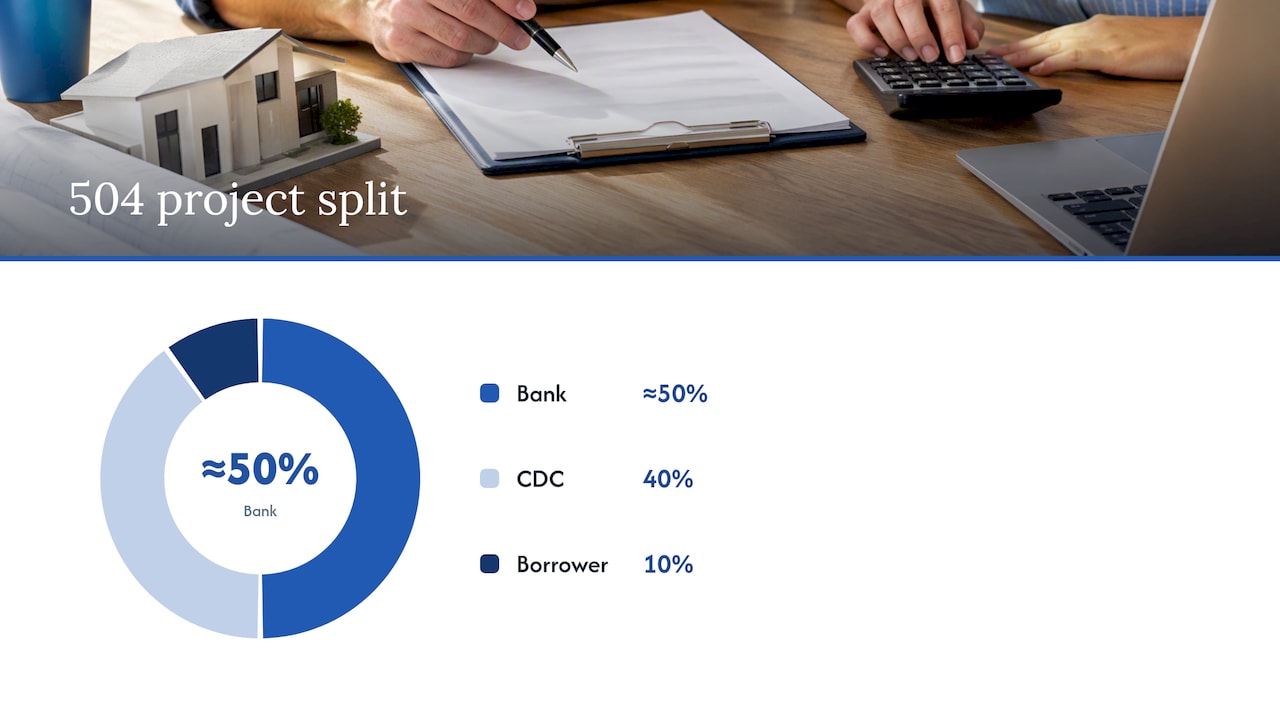
A worked example, using round numbers for illustration only: on a $2,000,000 property purchase, a 10% contribution is $200,000. The bank and CDC loans cover the other $1,800,000. Your CDC will give you the actual structure and costs for your deal.
Fixed-rate financing matters over a 20 or 25 year hold. The CDC portion does not reset, so a large part of your payment is predictable. The bank portion may have different terms, so confirm them early.
The 10% figure is a floor for a standard project. A project involving a startup or a special-purpose property may require a higher 15% equity injection. Special-purpose properties are those with limited alternative uses. Ask your CDC early whether your building is in that category.
If you are a startup, our guide on 15% to 20% down and what startups must document lists the paperwork lenders ask for.
The 504 program generally expects you to create or retain one job for every $75,000 of the SBA-backed debenture, or $120,000 for small manufacturers. Alternatively, a project can meet certain community-development or public-policy goals, per this banking-regulator summary. Existing employees count when the project retains their jobs, so many established businesses meet the goal without hiring.
Often, yes, with conditions. The SBA permits acquisition and installation of fixed assets, and the 504 program covers machinery and equipment with at least 10 years of useful life. Startups are not excluded, but lenders look harder at them, so expect a higher equity injection, a detailed business plan, evidence of your industry experience, and projections that show you can repay.
The general rules still apply. You must be an operating, for-profit U.S. business that meets SBA size standards, be creditworthy, and show a reasonable ability to repay. You must also be unable to obtain the credit on reasonable terms elsewhere, per the SBA’s 7(a) page. The SBA’s loans overview adds that each lender and program has its own requirements, and the lender supplies the complete list.
For equipment specifically, we walk through the tradeoffs in when equipment loans beat leases and how to match a loan term to useful life. Florida manufacturers can read our guide to 504 financing for equipment.
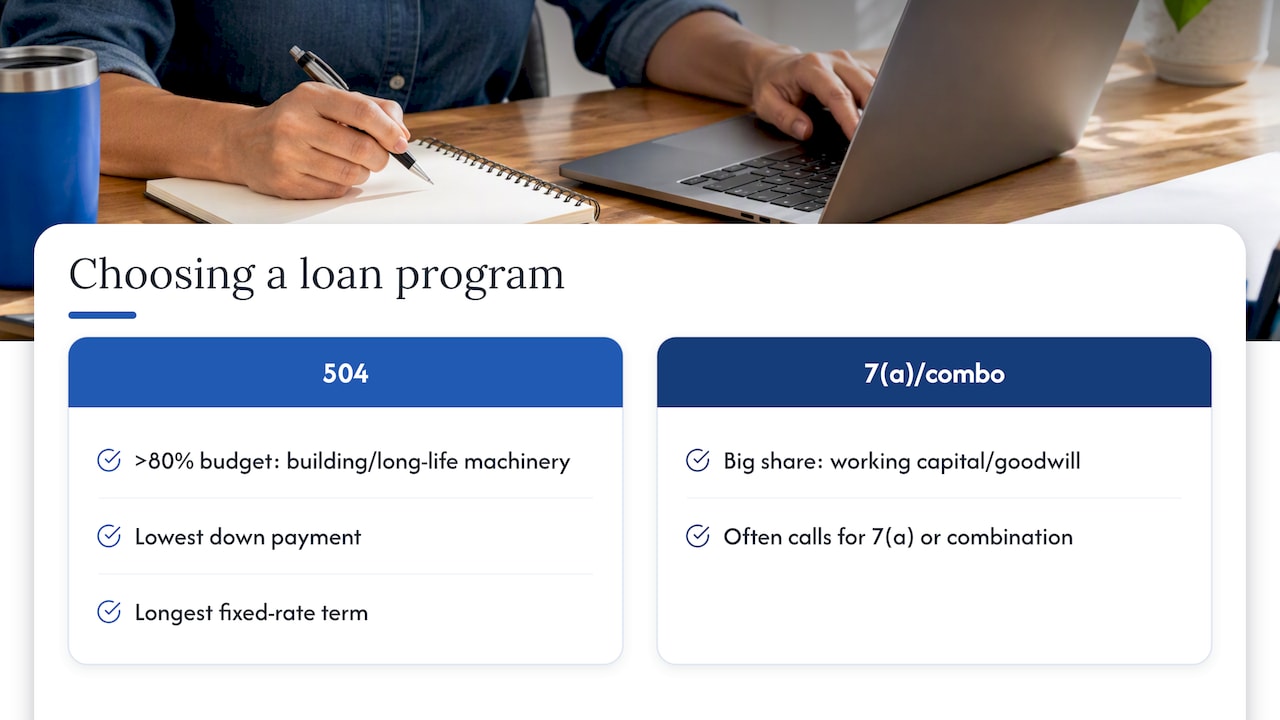
Most applicants we talk to arrive asking for “an SBA loan” and leave knowing which one. In our experience, the mistake is not picking the wrong lender. It is choosing a program before pricing the whole project. If more than 80% of your budget is a building or long-life machinery, the 504 structure usually delivers the lowest down payment and the longest fixed-rate term. If a big share of the budget is working capital or goodwill, the same project often calls for 7(a), or for a combination.
We have specialized in SBA 504 lending for over 35 years, and our focus is a fast, streamlined process with clear guidance at each step. We also pay attention to what happens after approval. A fixed rate and a long term only help if the payment fits your cash flow, so we encourage you to test the numbers with realistic revenue, not best-case revenue.
— PHENYX
FBDC is a Florida-based CDC. Depending on your project, these are the programs to look at:
If your project is a property purchase, start with our SBA 504 loan page, which also lists approximate fees. Tell us the property type, price and your timeline, and we will tell you which structure fits.
For a Florida property deal, a realistic close takes about 60 to 90 days with a prepared file. Our CDC checklist for real estate loans shows what to have ready, and our article on closing a 504 loan in Florida explains the stages.
The SBA’s rules give special consideration to veteran-owned businesses. For this rule, a veteran is someone honorably discharged from active military service. When a veteran does not apply, a business owned or controlled by a qualifying dependent can also qualify. The SBA processes these applications promptly, resolves close questions in the applicant’s favor and pays particular attention to maximum loan maturity. If you served, ask us about VetLoan Advantage Plus before choosing a program.
The application route differs by program.
If you want to see what 10% down looks like on a Florida property, read how to buy property with 10% down using SBA 504.
For an owner-occupied building, 504 is usually the better fit, because it offers long-term fixed-rate financing for real estate with a low down payment. 7(a) can also finance real estate, with terms up to 25 years including extensions. It makes more sense when the purchase also includes working capital or goodwill.
No. The SBA states that 504 loans cannot be used for working capital, inventory, or speculation or investment in rental real estate. If you need those, a 7(a) loan or a Microloan may cover them, or you can pair 7(a) with a 504 for the real estate.
A 504 project is structured around a 10% borrower contribution. It may rise to 15% for startups or special-purpose property. Your CDC will confirm the figure for your deal after reviewing the property and your business history.
Yes. Federal regulations direct the SBA to give special consideration to veteran-owned businesses, including prompt processing and attention to maximum loan maturity. FBDC also offers VetLoan Advantage Plus for veteran business owners.

