


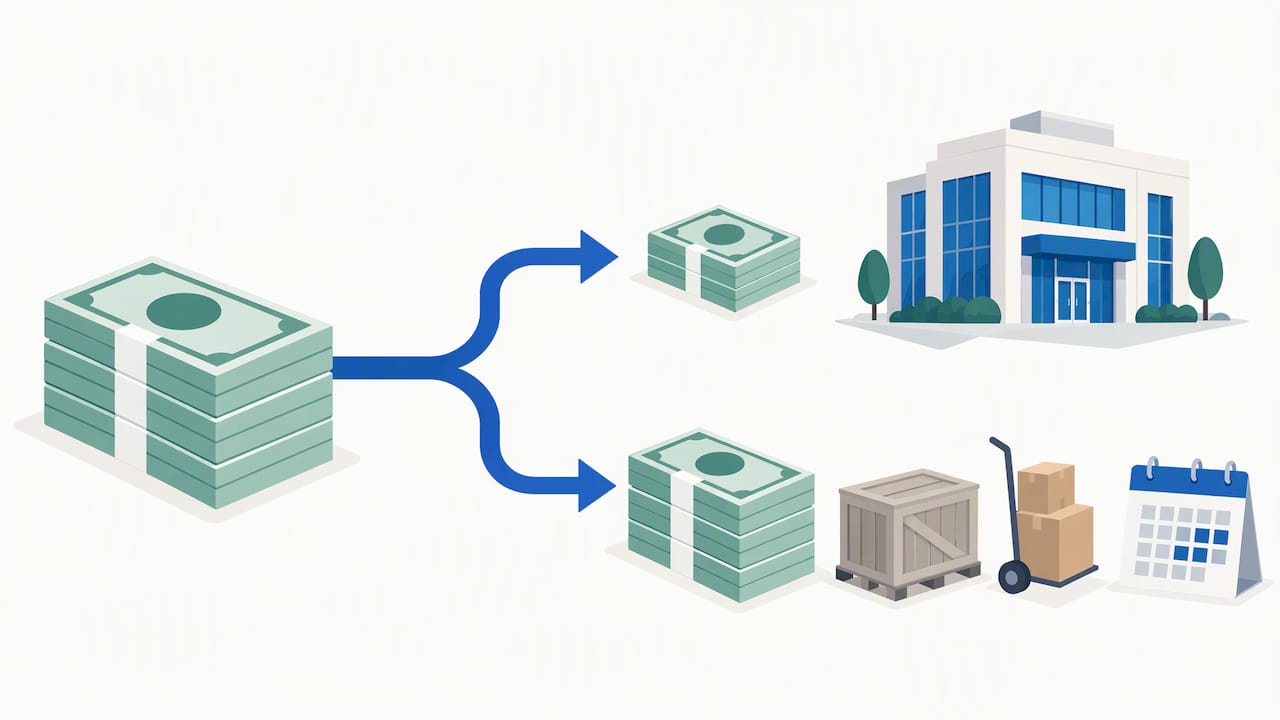
For an owner-occupied building, the cash you need can be as low as 10% of the total project cost with an SBA 504 loan. It rises to 15% or 20% for startups and special-use properties. Conventional bank financing often asks for far more, commonly 20% to 30% of the price. Whatever the structure, add Florida’s closing taxes, lender fees and some reserves to the down payment.
This guide shows how the numbers work, which costs count toward your equity, and how to estimate your own cash requirement before you make an offer.
Commercial lenders do not price a purchase the way a home lender does. They underwrite the property, the business and the borrower’s liquidity. The cash you bring is the main way they measure your commitment, and FDIC examination guidance on commercial real estate lending focuses on the borrower’s equity and the strength of the collateral.
Three structures cover most Florida purchases by small businesses:
| Structure | Typical cash down | Rate and term features |
|---|---|---|
| SBA 504 (owner-occupied) | 10% standard; 15% or 20% for startups or special-use property | Long-term fixed rate on the SBA-backed portion, up to 25 years for real estate |
| Conventional commercial mortgage | Often 20% to 30% | Terms vary; balloon payments after 5 to 7 years are common |
| Investment property loans | Often 25% or more | Depends on property type and lender |
The 504 program stands out because it is built for owner-occupants who want to keep working capital in the business. The SBA describes it as long-term, fixed rate financing for major fixed assets that promote growth and job creation. The program is for for-profit businesses buying or building real estate, or buying long-life machinery. It does not cover working capital or inventory.
A 504 project has three participants. A bank provides a first-lien loan, typically about 50% of the project. A Certified Development Company (CDC) provides a second-lien loan backed by an SBA debenture, typically about 40%. You provide the remaining 10%. The FDIC has published a description of the program from the bank’s side, which shows the same split.

A CDC is a nonprofit corporation certified and regulated by the SBA that works with private lenders to help growing businesses. The CDC portion is where the long fixed rate comes from. Conventional loans may reset or balloon after five to seven years. The 504 portion offers maturities of up to 25 years for real estate, so your payment on that share does not move with the market.
The SBA’s standard is 10%. It can increase in two situations:
If both apply, expect the high end of the range, 20%. Confirm which category your property falls in with your CDC early, because it changes your cash target by thousands of dollars.
Suppose a Florida contractor buys a $1,000,000 warehouse and the total project cost is also $1,000,000, with no startup or special-use factor.
| Line | Amount |
|---|---|
| First-lien bank loan (about 50%) | $500,000 |
| CDC/SBA second-lien loan (about 40%) | $400,000 |
| Borrower equity (10%) | $100,000 |
Compare that with a conventional loan at 25% down, which would mean $250,000 in cash. The 504 structure frees about $150,000 for inventory, hiring or a cushion.
If the same buyer were a startup, the equity would be 15%, or $150,000. With special-use property too, 20%, or $200,000. The project is the same, but the cash required doubles.
Buyers often budget the down payment and forget the debt-related taxes. Florida imposes two on the mortgage:
Both are due when the mortgage is recorded. Doc stamp tax on promissory notes is capped at $2,450, but that cap does not apply to the mortgage itself, so large loans can carry a real bill. Check the department’s guidance for how the tax applies to each document in your transaction.
Applied to the example above, on a $500,000 first mortgage:
That is $2,750 on the first mortgage alone, before any tax on the second-lien document. Have your closing attorney or title company run exact figures for both mortgages, because the way each document is taxed can change the total.
Other items to include in your cash plan:
The 10% is not always 10% of cash from your bank account on closing day. Lenders separate hard costs, such as land and building acquisition, from soft costs. Pre-development expenses like engineering, permits and professional fees can often count toward required equity if they are documented as out-of-pocket costs, according to the FDIC’s capital rule FAQ on contributed capital. Treat that as a point to confirm with your lender, since FDIC guidance is written for banks.
Practical steps:
Construction changes the cash timeline. The 504 loan is permanent financing, so a bank provides interim construction funds, and the CDC loan takes out part of that interim loan after completion. Banks often want the SBA’s debenture authorization in place before they commit fully. Read about avoiding a month of extra interim interest and how the construction and permanent loans fit together. For renovation, the 10% contingency cap lenders check affects how much you can finance.
Interim interest and contingency are part of the project cost, so plan for them in your equity figure.
We talk with Florida owners every week who start with “How much do I need down?” The better question is how much cash you can commit and still keep the business healthy afterward.
We have been in SBA 504 lending for over 35 years, and the pattern is consistent. Owners who put every dollar into the down payment have nothing left for equipment, moving costs or a slow first quarter. A lower equity requirement is not only about buying sooner. It is about keeping liquidity for the business that will pay the mortgage.
Fixed rates matter just as much. A payment that stays the same for decades is easier to plan around than one that balloons in five to seven years. That is why we steer owner-occupants toward 504 financing when they qualify, and why we want you to know early whether you do. A fast answer on eligibility saves you from signing a purchase contract you cannot close.
One piece of advice: line up your documents before you go under contract. A buyer with a clear equity source, records of pre-development costs and an early CDC conversation closes faster. Our checklist for a 60 to 90 day close on 504 real estate loans shows what to prepare, and our note on how long a 504 loan takes from application to funding sets expectations.
— PHENYX
Use this order:
Before this, check eligibility. Our four checks before approaching a CDC cover the points that decide whether 504 is open to you. Remember that the program is for businesses that occupy the property, not passive investors. Project size is also limited, and the limits have been updated, so see our summary of the current 504 loan limits.
If the numbers do not close with a standard 504 structure, FBDC has other programs. The Down Payment Assistance and Direct Lending programs serve smaller loans. If you are a veteran, VetLoan Advantage Plus is built for low down payments and fixed rates. If you need to move quickly on a purchase, the 504 Velocity Bridge Loan Program is designed for 504 projects. To see how your project would be structured, start with the SBA 504 Loan Program and talk with our team before you sign a contract.
With an SBA 504 loan on an owner-occupied property, 10% of the total project cost is the standard, rising to 15% or 20% for startups and special-use properties. Conventional loans often require 20% to 30%. Add closing costs, Florida mortgage taxes and reserves on top.
No. The 504 program is for businesses that occupy and use the property for their own operations. If you are buying purely to lease to others, you would look at conventional or investment property financing, which usually asks for more cash.
Yes. The state charges documentary stamp tax of $0.35 per $100 and a nonrecurring intangible tax of 0.2% on the amount a mortgage secures. Ask your closing attorney to calculate the exact amount for each mortgage in your deal.
Usually yes. A business that is new, or a property that suits only a single use, typically raises the 504 equity requirement from 10% to 15%. If both apply, it can reach 20%. Documentation matters, so prepare financial projections and proof of your experience.

